
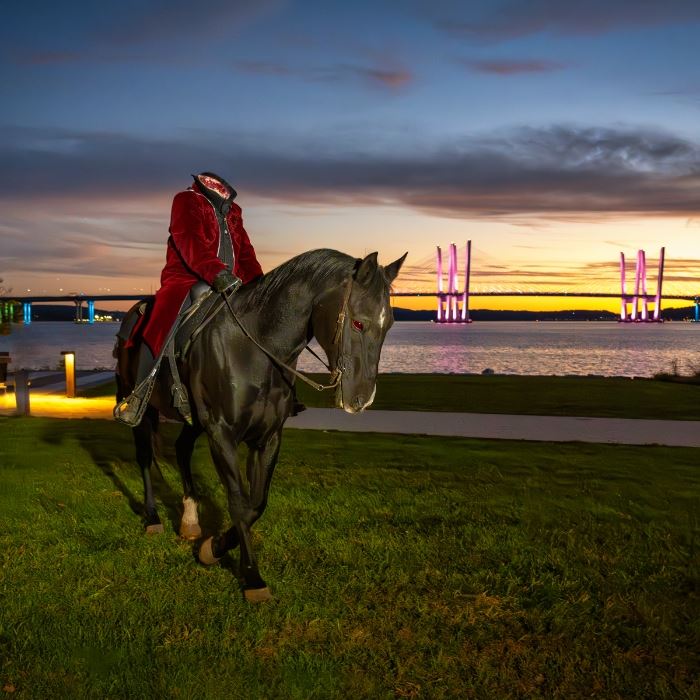
from Bennet D.
Photo credit via Village of Sleepy Hollow NY
Sleepy Hollow, Westchester County New York, has a rich past of Native American roots, colonial enterprise, industrial expansion, and enduring literary renown thanks to Washington Irving’s 1820 tale, The Legend of Sleepy Hollow. Before Europeans arrived, the Weckquaesgeek branch of the Lenape people called the area home, referring to it as Alipconk, or “place of the flowing tide,” a nod to its winding waterways.
The colonial period began in the early 1600s when the Dutch established New Netherland. By 1640, the tract that would evolve into Sleepy Hollow had been incorporated into Philipsburg Manor, a landholding acquired by Dutch merchant Frederick Philipse. Under his direction, the manor emerged as a bustling agricultural and trading center reliant on enslaved Africans for labor. Among the surviving landmarks is the Old Dutch Church, erected around 1685, which Irving later immortalized as the spot where Ichabod Crane faces the Headless Horseman. After England seized New Netherland in 1664, the community continued as farmland and milling district. The Philipse family maintained control until the Revolutionary War, when their allegiance to the Crown cost them their estates. Then known as North Tarrytown, the area witnessed small-scale wartime skirmishes and, in 1780, the capture of British agent Major John André nearby.
In the 19th century, North Tarrytown blossomed into an industrial hub. The river facilitated shipping, and the completion of a railroad line in 1849 accelerated growth. Factories sprang up—first a steam engine works, later Chevrolet’s assembly plant in 1914—drawing waves of Irish, Italian, and other immigrants seeking work. It was during this era that Washington Irving, a native of Tarrytown, published The Legend of Sleepy Hollow in The Sketch Book of Geoffrey Crayon, Gent. Set in the superstitious, misty valley of Sleepy Hollow, the story introduced the spectral Headless Horseman—said to be the restless spirit of a Revolutionary War Hessian soldier. Irving’s tale, steeped in the region’s Dutch folklore, cemented Sleepy Hollow’s place in American culture. His Gothic Revival estate, Sunnyside, still stands just south of town.
Through the early 20th century, the village—still called North Tarrytown—remained anchored in manufacturing, but by the century’s end, industry had waned. The closure of the General Motors plant in 1996 dealt a blow to the local economy. That same year, residents voted to swap the village’s name for Sleepy Hollow, embracing Irving’s legacy to invigorate tourism and civic pride. The new moniker already graced festivals and school team names like the Horsemen (I wonder if that is a good name), and local shops.
Today, Sleepy Hollow is a thriving community celebrated for its historic attractions and its role in Halloween lore. Visitors flock to Philipsburg Manor, a painstakingly restored 17th-century estate that interprets colonial life and the region’s history of enslavement; to the Old Dutch Church and Burying Ground, now a National Historic Landmark; and to Sleepy Hollow Cemetery, the burial site of Irving, Andrew Carnegie, and other luminaries. The Headless Horseman Bridge, spanning a creek near the story’s famed setting, draws photo seekers year-round. Each fall, the Sleepy Hollow Halloween Festival enlivens the village with haunted hayrides, lantern tours, and thrilling recreations of the Horseman’s midnight chase. Just 25 miles north of Manhattan, where the Hudson’s vistas meet suburban streets, Sleepy Hollow balances its storied past with modern living.
For more information on Sleepy Hollow and their events: https://www.sleepyhollowny.gov/
Tags: #VisitSleepyHollow #NewYork #Westchester #HeadlessHorseman #Autumn #Fall #Halloween #FamilyFun #SleepyHollowEvents #ScenicFall #HalloweenInNY #FamilyAdventures #FallFestivities #VisitNY #SleepyHollowNY #OutdoorFun #CultureAndHistory #SpookySeason #FestiveCelebration #FamilyTime




 Vivid Society NY
Leave a comment